There are moments in every educator’s life when a simple question refuses to leave the mind: What is education truly meant to accomplish? Is it merely a means to secure employment, improve economic mobility, or earn social recognition? Or is it something far deeper—a lifelong process that shapes the way individuals think, live, question, and contribute to society?
For me, that question has become increasingly relevant in an age where artificial intelligence can generate essays, algorithms can solve complex equations in seconds, and information is available at the touch of a screen. Never before has humanity had such unprecedented access to knowledge, yet educators across the world continue to worry about declining curiosity, growing anxiety among students, diminishing attention spans, and the gradual disappearance of meaningful mentorship. Ironically, as information becomes limitless, wisdom appears increasingly scarce.
Searching for answers inevitably leads back to India’s own educational heritage. Long before the rise of Europe’s medieval universities or the formalization of modern schooling, the Indian subcontinent had already developed a remarkably sophisticated educational philosophy known as the Guru–Shishya Parampara, or the Gurukul system. It was not simply a residential school where students memorized sacred texts. It was a living ecosystem in which learning, discipline, ethics, inquiry, community life, and personal transformation were inseparable.
Modern discussions often describe education as multidisciplinary, experiential, student-centred, or competency-based. These ideas are frequently presented as innovations of contemporary pedagogy. Yet when one studies ancient Indian educational traditions, it becomes evident that many of these principles have deep civilizational roots. The Gurukul encouraged students to learn not only through instruction but also through observation, dialogue, practical work, debate, reflection, and everyday living. Knowledge was never viewed as information to be accumulated; it was considered a means of understanding oneself and one’s place in the larger order of society and nature.
This educational philosophy emerged during the Vedic period and gradually evolved into one of the world’s earliest organised systems of higher learning. Ancient Indian texts repeatedly emphasise that education should cultivate humility before expertise.
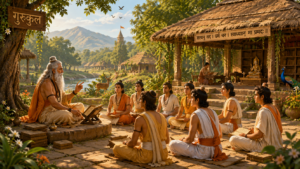
GURUKUL
“विद्या ददाति विनयं, विनयाद् याति पात्रताम्।”
“Knowledge gives humility, and humility makes one worthy.”
Perhaps this is the most striking difference between the Gurukul and many contemporary educational models. Ancient Indian education did not begin by asking, “What career will this student pursue?” It began by asking, “What kind of human being will this student become?”
Students lived with their teachers, sharing everyday responsibilities alongside intellectual pursuits. Learning extended far beyond scripture. Mathematics, astronomy, medicine, linguistics, governance, agriculture, architecture, music, philosophy, environmental stewardship, and ethics formed part of an integrated curriculum. Intellectual excellence was expected to coexist with emotional maturity, physical discipline, and moral responsibility. The teacher was not merely an instructor but a mentor whose greatest responsibility was to nurture discernment rather than dependence.
Historical evidence suggests that this educational vision was far more expansive than is often acknowledged. Centres of learning such as Takshashila, flourishing from at least the sixth century BCE, attracted scholars from Persia, Central Asia, and different regions of the Indian subcontinent. Later, Nalanda Mahavihara became one of the largest residential universities in the ancient world, welcoming thousands of students from China, Tibet, Korea, Sri Lanka, and Southeast Asia. Chinese travellers Xuanzang and Yijing left detailed accounts describing rigorous academic debate, extensive manuscript libraries, and a scholarly culture that valued intellectual freedom as much as discipline.
These accounts remind us that India’s educational history was never isolated from the rest of the world. On the contrary, it was deeply international. Knowledge travelled across borders long before modern globalisation became a reality.
Equally significant, though less frequently discussed, is the participation of women in India’s earliest intellectual traditions. Popular narratives often assume that women were universally excluded from ancient education. The evidence tells a more nuanced story.
The Rig Veda, one of humanity’s oldest surviving literary works, preserves hymns attributed to women seers including Lopamudra, Apala, Ghosha, Vishvavara, and Vak Ambhrini. Their authorship demonstrates that women were not merely recipients of knowledge but contributors to India’s earliest philosophical literature. The Brihadaranyaka Upanishad goes even further by presenting Gargi Vachaknavi in a public philosophical debate with the sage Yajnavalkya before the court of King Janaka. Her questions on the nature of existence continue to be studied by philosophers more than two millennia later. Likewise, Maitreyi’s dialogue with Yajnavalkya reflects a sophisticated engagement with questions of consciousness, immortality, and the meaning of knowledge itself.
These examples should not be interpreted to mean that educational access was universally equal across all regions or communities. Ancient India was vast and socially diverse, and opportunities undoubtedly differed according to geography, occupation, and local customs. Nevertheless, they challenge the simplistic assumption that women occupied no place within India’s early knowledge traditions. History, as always, is richer and more complex than the narratives we often inherit.